
Spray Fan Control Board: Mist, Speed & Production Guide
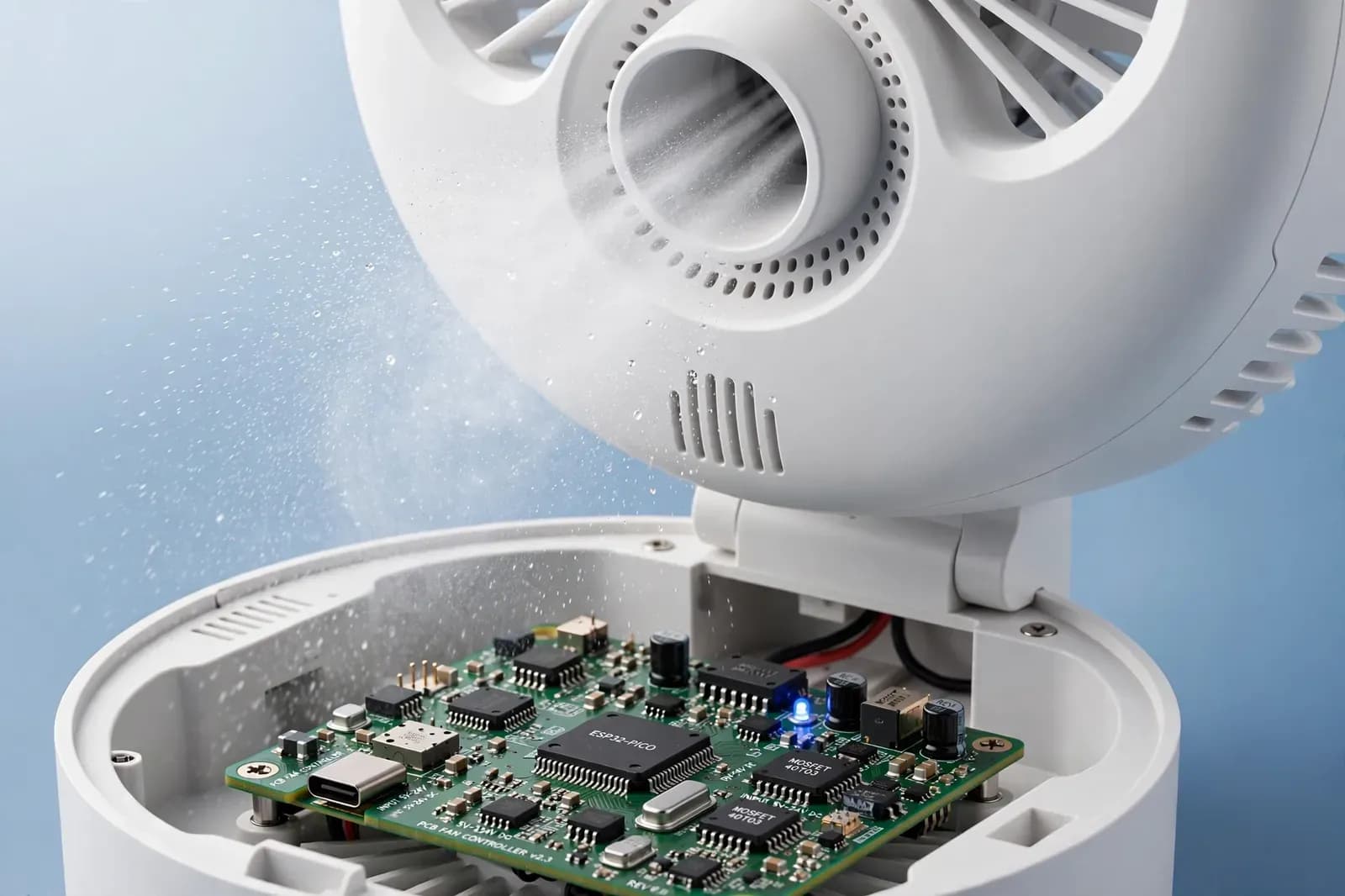
Weak mist on a spray fan is usually a control board issue. This guide explains mist drive, speed linkage and dry-run protection, plus six mass-production pitfalls to avoid.
Desktop spray fans are everywhere now — on office desks, in dorm rooms, at outdoor stalls. But buyers keep reporting the same complaints: crank it to max and the wind arrives while the mist gets blown away into nothing; the tank still has water, yet the mist output shrinks day by day; or the charging port is some outdated connector nobody stocks cables for anymore.
Most of the time, the fan blades aren't the problem. The control board is. In a spray fan, the control board orchestrates three things — mist, airflow, and power — and if any one of them is poorly coordinated, the whole product drops a grade.
What the Control Board Actually Manages
For such a small device, the control board wears a lot of hats:
- Multi-speed airflow: PWM speed control driving the fan motor, from sleep breeze to turbo;
- Mist drive: the microporous ultrasonic atomizer needs a drive signal at its exact resonant frequency — miss the frequency and there's no mist;
- Water-level sensing and dry-run protection: the board must shut things down when the tank runs dry, or the atomizer burns out after a few dry runs;
- Oscillation: driving a small motor that sweeps the mist head side to side;
- Lighting and display: RGB ambient lighting, plus a digital display showing speed, battery, and timer status;
- Charging and battery management: Type-C fast-charging handshake, lithium battery charge/discharge protection;
- Add-on features: auto-off timer, IR or Bluetooth remote, app control, mist output adjustment, natural-breeze and sleep modes.
Jushi's JS-FS315 spray fan control board ships with exactly this function set: multi-level wind speed, RGB lighting, mist oscillation, Type-C fast charging, and a digital display — with remote control, app control, timer, low-water alerts, and mist adjustment available as options.
How to Choose the Core Design
Atomization: microporous ultrasonic is the standard for desktop units
There are two main atomization routes. Desktop products almost universally use microporous ultrasonic atomization: the atomizer plate's micro-holes vibrate at ultrasonic frequency and break water into fine mist. Off-the-shelf atomizer driver modules typically run at a fixed frequency around 108kHz at low power (about 2W), work off 5V or Type-C power, and are compact and low-consumption — a natural fit for desktop appliances.
The alternative is a high-pressure pump plus nozzle setup. It produces more mist, but it's bigger, noisier, and hungrier for power — suited to industrial cooling or large floor-standing units, not desktop products. The dividing line is really the product form factor: for a compact desktop device, microporous ultrasonic is essentially the only sensible choice.
Motor: go brushless, and link speed to mist output
Fan motors come in brushed and brushless flavors. Brushless motors run quieter and last longer, and industry reports flag quiet motors as one of the key product differentiators. PWM multi-speed control on the board is the easy part; the hard part is linking the speed curve to mist output — more mist at high speed, less at low speed (sleep mode). Without that linkage you get two classic failures: high speed blowing the mist into invisibility, or low speed leaving a film of water droplets on the desk.
Water-level sensing: get the protection sequence right
Float-plus-Hall and capacitive sensing are the two common approaches, and neither costs much. What matters is the logic: on low water, the board must stop the atomizer first, then raise the alarm. Some designs do it backwards — alarm first, stop later — and those few seconds of dry running are enough to scar the atomizer plate. Mist output never fully recovers.
Power: Type-C fast charging plus solid battery management
Type-C fast charging with a lithium battery is now standard on desktop spray fans. Charge management has to be complete: over-charge, over-discharge, and over-current protection, all of them. Battery safety feeds directly into product compliance, and battery-powered models need dedicated battery safety certification for export — budget for that at project kickoff, not as an afterthought.
The Most Common Mass-Production Pitfalls
Picking the right design is only step one. What separates a decent product from a good one is what happens in mass production. Here are the classic failure points for spray fan control boards:
1. Atomizer frequency drift. The resonant frequency of an atomizer plate drifts with temperature and water quality. If the drive frequency doesn't track it, mist output falls off a cliff. Build in frequency tracking in production, or at minimum leave calibration headroom — don't lock in the lab's room-temperature sweet spot and call it done.
2. Backwards dry-run protection. As noted above: stop first, alarm second. When reviewing firmware, check this line before anything else — it matters more than a hundred features.
3. Mineral scale clogging the micro-holes. In hard-water regions, scale builds up over months and chokes the micro-holes. Make the structure easy to disassemble and clean, and consider a usage-hour-based "time to clean" reminder alongside the low-water alert. Small touch, big difference in perceived quality.
4. Wind and mist tuned separately. Speed and atomizer power have to be tuned in one coordinated logic, not by two engineers working in isolation. The unglamorous but effective fix: measure mist output and desk condensation at high, medium, and low settings before every production run.
5. Jerky oscillation. Mist oscillation usually runs on a small motor plus gear train. Sloppy gears or off-center assembly make the sweep stutter — and in bad cases the head clips the mist outlet. Lock down gear tolerances and assembly specs at the prototyping stage; don't loosen them in production.
6. Skimped charging and safety testing. Type-C handshake behavior and battery protection need full coverage in production sampling. A surprising number of returns trace back to charging-section components quietly swapped during mass production.
Closing
The bar for a spray fan was never "does it make mist." It's whether mist, airflow, and power keep working together, reliably, for months. The control board is what holds the three together: design choices set the floor, and protection logic plus production discipline set the ceiling.
If you're developing a spray fan, misting fan, or air-cooler product and need a custom control board solution, feel free to contact us through our website — from solution design and firmware development to PCB layout, prototyping, and mass production, Jushi Optoelectronics offers one-stop support. See also our JS-FS315 Spray Fan Control Board.
Sources
- PmarketResearch, "Household Mist Fan Market": household mist fan market size ~USD 303 million in 2026, ~6.45% CAGR 2025–2032; technology trends include ultrasonic misting, IoT smart control, and quiet motors. https://pmarketresearch.com/hc/household-mist-fan-market/
- PmarketResearch, "Portable Spray Fan Market": ~5.85% CAGR 2025–2032; differentiation centers on high-efficiency ultrasonic nebulization, brushless motors, and fast-charging battery technology. https://pmarketresearch.com/hc/portable-spray-fan-market/
- 2W Ultrasonic Mist Maker module manual (Manuals.plus): 108kHz fixed resonant frequency, atomization ≥50ml/h, auto-off timer against dry burning. https://manuals.plus/ae/1005005321213523
- Best Modules BMN31K502 microporous atomization module datasheet: 108kHz atomization frequency, UART networked mode with configurable atomization power and timing. https://www.bestmodulescorp.com/sc/amfile/file/download/file/1052/product/1137/