
Space Heater Control Board: Safety, Thermostat & Production Guide
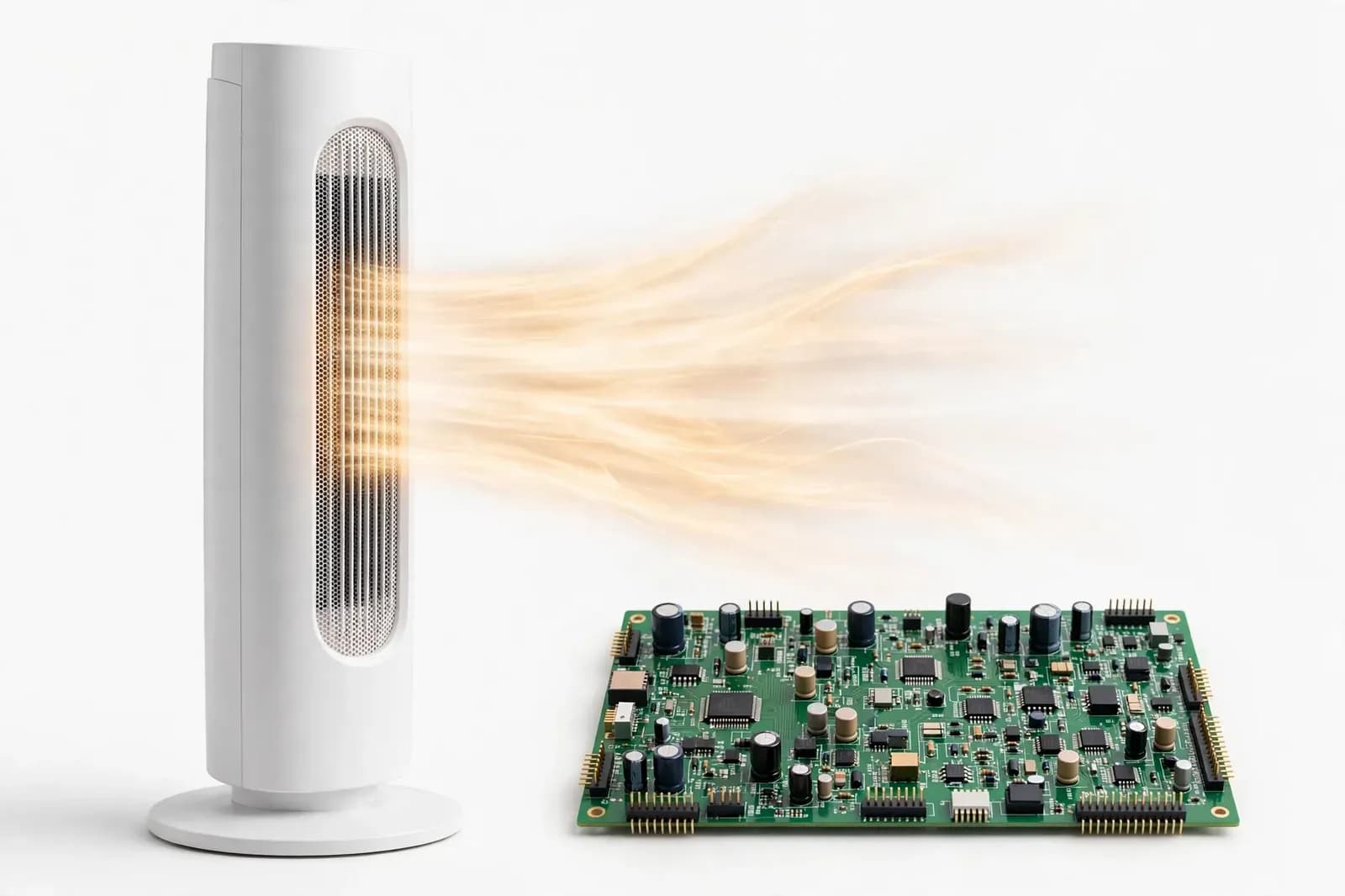
Overheating, tip-over and unstable thermostats drive space heater returns, and the control board is usually at fault. This guide explains the NF-2118 heater board's safety and thermostat design, plus six production pitfalls.
Every winter, space heaters sell fast — and generate a disproportionate share of complaints. A unit that shuts off without warning, blows hot then cold, or keeps heating after it tips over will earn a return and a bad review faster than any other small appliance flaw.
Most of those failures trace back to the control board, not the housing or the fan. A heater board switches high-power heating elements, manages fan speed and oscillation, and is expected to cut power before anything goes wrong. Get it right and the product survives winter after winter; get it wrong and one safety incident can end a brand in a channel.
What the Control Board Actually Manages
A space heater board juggles several jobs at once:
- Heat and fan modes: cold air, low heat, high heat — the fan and heating element must start and stop in the right order, never full-power dry heating from a cold start.
- Thermostat control: a temperature sensor reads room temperature, dropping to a lower setting or cutting off at the set point, then resuming when the room cools, so the room stays steady instead of swinging hot and cold.
- Overheat protection: if the outlet is blocked or the fan stalls, internal temperature climbs fast, and the board must cut heating before it runs away.
- Tip-over shutoff: if the unit is knocked over by a child or a pet, power must cut immediately. This is the one safety feature a heater board cannot skip.
- Oscillation and timer: an oscillation motor sweeps the airflow, and a timer lets the unit switch itself off rather than running all night.
- Display and controls: heat setting, temperature, and timer status must be readable at a glance, and buttons and remote commands must respond without lag.
The Jushi NF-2118 space heater control board covers this set as standard: heat and cool modes, overheat protection, oscillation, timer control, tip-over shutoff, and digital display. Power input, connector placement, and board outline are tailored to the customer's finished product — see the NF-2118 Space Heater Control Board.
Comparing the Core Options: Heating Element and Thermostat
PTC Ceramic vs. Resistance Wire
This is the first decision when a heater design takes shape. A PTC ceramic element is self-limiting: as its temperature rises, its own resistance rises, so its power draw falls automatically — the element effectively brakes itself. A resistance wire behaves differently: its resistance barely changes with temperature, so it keeps heating until an external control tells it to stop.
Neither route is universally better. PTC gives a thicker safety margin — even if the thermostat path fails, the element itself resists running away — but the element costs more and constrains the board layout. Resistance wire is cheaper and more flexible in shape, but the board's thermostat and overheat protection must be correspondingly stricter, because nothing else backs them up. Decide the price band and the target market's certification requirements first, then place the safety budget accordingly.
Mechanical Thermostat vs. Electronic Control
Older heaters use bimetal mechanical thermostats: simple and cheap, but with a wide temperature band, so room temperature swings several degrees and the room feels alternately hot and chilly. Electronic control closes the loop with a sensor and a microcontroller, holding temperature tighter and enabling timer, display, and remote functions that lift the whole product upmarket.
The price of electronic control is software discipline. A sensor mounted in the wrong spot reads outlet air instead of room air, and the unit cycles constantly. Poor debouncing and filtering makes the temperature curve jitter. Electronic thermostat logic has to be tuned on the finished unit, not just verified on the bare board.
Fan and Oscillation: Don't Let Airflow Lag the Heat
Fan and heater must be sequenced: fan first, then heat; at shutdown, heat off first, fan running on briefly to carry away residual heat. Reverse that order and the element dry-fires for seconds at a time, costing lifespan and safety margin. The oscillation motor needs stall protection too — if the sweep jams, the board should detect the rising current and stop pushing.
Six Production Pitfalls to Watch
Heater boards often pass small-batch validation, then fail in volume production:
- Overheat protection tested at room temperature only: a half-blocked outlet, a hot environment, and high mains voltage together can push the trip point past where the lab test said it was.
- Tip-over switch mounting drift: tip-over switches are sensitive to mounting angle. A small assembly deviation means either no shutoff when tipped, or false shutoffs when upright — both are batch-scale defects.
- Temperature sensor in the wrong place: too close to the element and the unit thinks the room is warm seconds after switch-on; too far from the airflow and it overshoots before reacting. Sensor placement must be fixed on the finished unit.
- Relay and high-current routing undersized: heater elements draw large currents. A relay without margin, or copper too thin for the load, runs hot after a few hundred hours, and solder joints fail first.
- Buttons and display failing in the cold: at winter switch-on temperatures, capacitive button sensitivity and display brightness can drift. Products bound for cold climates need low-temperature validation before shipment.
- One design shipped to every market: mains voltage, frequency, and certification requirements differ by country. Shipping a board qualified for one market worldwide guarantees certification and after-sales rework later.
Conclusion
A space heater sells peace of mind in winter. Buyers never open the unit to praise the control board — but a single safety failure can end a brand in a channel. Overheat protection, tip-over shutoff, and a steady thermostat, validated across combined worst-case conditions, are what make a heater line durable.
The market is moving the same way: research firms differ on market size, but agree that models with safety protection and digital controls are replacing bare switch-and-dial units. The steadier the board, the stronger the product's position in the channel.
If you need a custom space heater control board, contact us through the official website with your product structure, feature requirements, and target markets — we develop the solution, confirm it on prototypes, then move to volume production.
Sources
- 360iResearch, "Electric Space Heater Market" via MarketResearch: USD 7.12 billion in 2025, USD 7.49 billion projected for 2026, USD 10.88 billion by 2032, CAGR 6.23%.
- Global Market Insights, "Residential Space Heater Market": USD 6.24 billion in 2025, USD 6.63 billion in 2026, USD 11.97 billion by 2035, CAGR 6.8%.
- U.S. Consumer Product Safety Commission figures cited by Western University: more than 25,000 residential fires per year associated with space heater use, causing more than 300 deaths.
- National Fire Protection Association figures cited in public safety guidance: 2020–2024 averages, space heaters involved in about 30% of home heating equipment fires but 73% of the deaths.
- PTC vs. resistance-wire heating principles: PTC ceramic resistance rises with temperature and self-limits, while resistance wire needs external thermostat control, as described across PTC manufacturer technical notes and heater technology guides.