
Pet Fountain Control Board: Water Level, Dry-Run & Quiet Pump
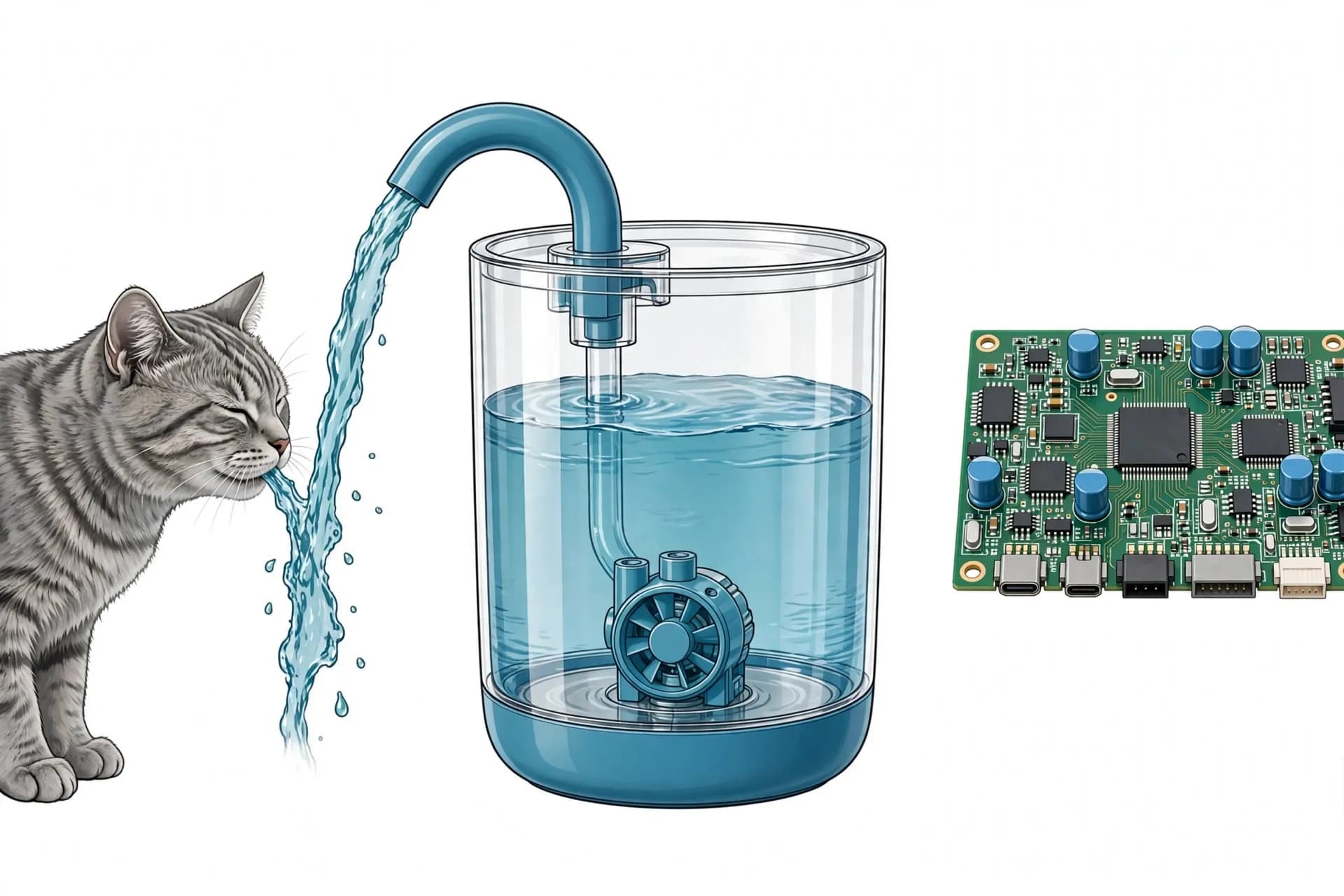
Pump dry-burning, noisy nights, stale water — most pet fountain failures trace to the control board. How water-level sensing, dry-run protection, and BLDC pumps fix them.
A pet water fountain that buzzes all night, burns out its pump by running dry, or lets water go stale — most of these complaints trace back to the control board. This article takes apart a typical pet fountain control board: how it senses water level, how it prevents the pump from dry-running, and what quiet operation actually depends on.
1. What the Control Board Does in the Whole Machine
Strip a fountain down, and the control board's job is one chain:
Power → Main MCU → Pump drive → Water circulates upward → Filtration → Back to the drinking tray
At the same time it has to watch four things: tank water level, whether a pet is nearby, how long the filter has been in use, and user input from buttons or the app. When the water level is too low, the pump must stop first — more on that below.
A typical control board covers: water-electric separation, infrared sensing, constant-temperature control, filter-replacement reminders, water-level detection and dry-burn protection, intermittent / continuous dispensing modes, and dual power (plug-in + battery). The feature list looks long, but it comes down to three blocks: water-level sensing, pump drive, and power plus safety.
2. The Core Logic: Check the Water Level Before Starting the Pump
A fountain-related patent lays out the control flow, and the priority is clear:
- The infrared sensor checks whether a pet is approaching. Only when a pet is near is there drinking intent, so the machine responds; when nobody is near, it stays off, instead of running the pump nonstop and wasting resources.
- The water-level sensor checks whether there is enough water. Only with sufficient water does the pump start; with too little water, the machine refills (or alarms and stops).
- The pump must never run dry when the water level is low. The patent states it plainly: too little water causing the pump to dry-burn can lead to safety accidents, and water-level detection exists to prevent exactly that.
This order must not be reversed. Many cheap designs run the pump whenever powered on — the tank runs dry and the pump keeps spinning, overheating and burning out at best, and driving returns at worst. In production designs, the water-level decision must be the highest priority, and it must not go through a slow polling loop: low water → stop the pump immediately → light the low-water indicator (or push an app alert). That chain should be as short as possible.
Dual modes are an extension of the same logic: continuous mode keeps the pump circulating; smart mode uses infrared sensing to work intermittently, dispensing only when a pet approaches — saving power and extending filter and pump life.
3. Water-Level Sensing: Three Options
Like humidifiers, fountains have three mainstream water-level sensing options, with similar trade-offs:
- Float + reed switch: reliable and cheap. The float rises and falls with the water level, and the reed switch gives the MCU a clean on/off signal. The downside is the mechanical structure — long-term immersion needs attention to limescale jamming and sealing.
- Capacitive sensing: no moving parts; mounted on the tank's outer wall or built into the board, it detects the water level from capacitance change. It resists limescale better and can do multi-level sensing (paired with a row of LEDs for a water-level display, as in the patent). But the circuit needs more careful tuning.
- Infrared photoelectric: an emitter + receiver pair detects water / no-water, with fast response and no mechanical wear. The downside is that limescale and air bubbles can disturb the light path, so mounting position matters.
Whichever method is used, the firmware logic should be the same: low water → stop the pump immediately → alarm. Some designs add one more layer: if the level sensor itself fails (signal unchanged for too long, or outside a plausible range), the machine also stops and alarms, so a dead sensor cannot let the pump run dry.
4. The Pump: Why Quiet Designs All Go Brushless
The pump is where fountain noise and lifespan are decided. Two routes exist: brushed and brushless.
Noise: brushed DC pumps have carbon-brush friction + commutation sparking and audible buzzing; brushless DC pumps have no brush friction, smooth operation, and lower noise and EMI.
Lifespan: brushed brushes wear out, shorter life; brushless is practically maintenance-free, only bearings wear, longer life.
Efficiency: brushed has contact resistance and friction losses; brushless has higher efficiency and cooler operation.
Drive: brushed has a simple circuit and low upfront cost; brushless needs a driver for commutation and higher initial cost.
Smart control: fine speed control is hard with brushed; brushless supports speed regulation, dry-run / over-current / over-voltage protection.
On lifespan figures, sources differ: brushless designs are generally rated 15,000–20,000 hours (some vendors claim over 20,000), brushed designs around 5,000–8,000 hours. Don't take rated numbers at face value — a fountain pump runs immersed long-term, and sealing and bearings are where lifespan is actually decided.
On noise, mainstream products commonly claim around 20 dB or below 30 dB. What the control board can do: PWM speed control to keep the pump in its quiet range, intermittent mode to cut total runtime, and shock absorption in the structure. Swapping the pump alone without fixing the drive won't get you quiet.
Water-electric separation is another safety line: wireless-pump designs keep the pump fully separate from the water tank, so the motor and circuitry never sit in water; even if the tank leaks, the shock risk is far lower. When laying out the board, keep the power section physically away from the water path and protect the critical areas — moisture ingress is one of the most common failure modes for fountain control boards.
5. The Rest: Power, Filter Reminders, Temperature, and Interaction
- Power: typically a 5 V USB / DC adapter, or lithium battery with plug-in + battery dual use. Brushless pumps generally run at 3.5 V–24 V, below the 36 V safety voltage. Leave headroom in the supply — pump inrush current at startup is not small; battery models also need charge/discharge management and low-battery alarms.
- Filter reminders: two routes — time-based accumulation (e.g., remind every 30 days), or flow-based accumulation (a Hall-effect flow sensor counts volume). Time-based is simple but imprecise (water usage varies); flow-based is more accurate but adds a sensor. Reminders usually come as an LED color change or an app push.
- Constant temperature: heated models use an NTC thermistor for temperature sensing + PID control to hold the set water temperature. Heating, like the pump, must be gated by water-level protection: no heating when dry or when the level is too low, to prevent dry burning.
- Interaction: touch buttons, LED water-level indicators, numeric displays; connected models add a Wi-Fi / Bluetooth module for app control, filter-life display, and OTA updates.
6. From a PCBA Viewpoint: Where Mass Production Trips Up
- Pump stall. Pet hair and limescale can jam the impeller, and stall current spikes. The board must have stall / over-current protection: stop the pump and alarm when current exceeds the threshold, or the drive transistor burns first.
- Infrared false triggers. Infrared sensing is sensitive to strong light, and pets walking past can trigger it constantly. Thresholds and debouncing need real-world tuning, not datasheet defaults.
- Filter-reminder false alarms. Time-only reminders annoy users who change water often; flow-only reminders drift when the sensor gets dirty. Combining both, with a manual reset, is the steadier approach.
- Moisture ingress. The inside of a fountain is humid. If the control board sits too close to the tank without conformal coating, solder joints corrode over time and leakage-current problems follow. Keep the layout away from the water path and protect the critical areas.
- Limescale and cleaning. Level sensors and pump bodies sit in water long-term; limescale buildup affects sensing and flow. The structure should be easy for users to disassemble and wash; what the board can do is enforce strict detection and complete fault alarms.
Conclusion
A pet fountain control board comes down to three things, same as a humidifier's: get water-level sensing right, make dry-run protection the highest priority, and choose a brushless pump with the drive and quiet operation done properly. Get those three right, and power, filter reminders, temperature control, and interaction are mature building blocks. That is what low return rates and user reputation rest on.
Sources
Control flow (infrared sensing → water-level detection → preventing pump dry-burning): Patent CN114514886B (water feeder); control board with water-level detection, water-level display LEDs, touch buttons: Patent CN219323062U (pet water fountain with water-level detection); quiet pump (approx. 20 dB / below 30 dB), dry-run protection auto-stop, dual modes, low-water alarms: multiple fountain product listings (cross-checked); brushed / brushless comparison (noise, lifespan, efficiency, drive): Fluid Metering brushed vs. brushless motor whitepaper; brushless 15,000–20,000 h, brushed 5,000–8,000 h: Accio DC water pump data; brushless over 20,000 h, 3.5 V–24 V operating voltage, integrated dry-run protection and other smart controls: TOPSFLO brushless DC pump data; water-electric separation, wireless pump: pet fountain hands-on review; water-level sensing options (float / infrared photoelectric / capacitive), dry-burn protection, filter life and OTA: smart water dispenser MCU solution write-up. Lifespan, noise and similar figures are quoted from vendors and public sources and vary by manufacturer and test conditions — verify by measurement when selecting parts.