
Aroma Diffuser Control Board Guide: Mist Drive, Safety, Pitfalls
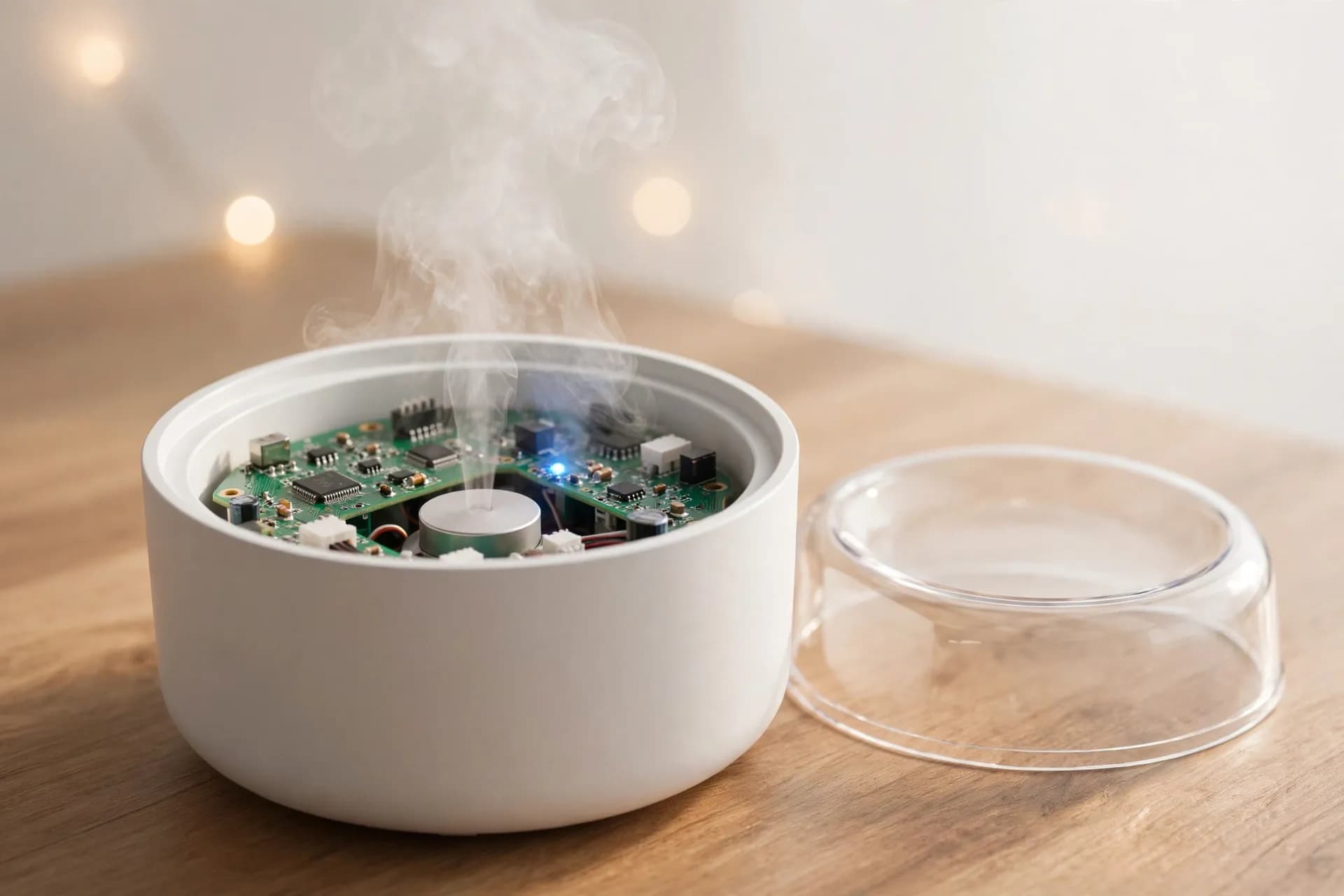
Weak mist and dry-burn failures trace back to the control board. Guide to aroma diffuser drive circuits, water-shortage protection and production pitfalls.
Every aroma diffuser brand runs into the same complaints sooner or later: the mist gets weaker after two or three months, the unit keeps running dry and the transducer starts to smell burnt, the water-level indicator flickers for no clear reason. The usual first reaction is to switch transducer suppliers — and then the problems stay. More often than not, the root cause sits in the control board design.
Aroma diffusers share the same ultrasonic atomization principle as humidifiers (we covered humidifier control boards in an earlier article), but essential oils, ambient lighting and intermittent misting add usage patterns that make the control board's job more complicated, not less. Here is the full breakdown.
What the Control Board Actually Manages
At the heart of every ultrasonic diffuser is a piezoelectric ceramic transducer, most commonly specified at 1.7MHz or 2.4MHz. The transducer itself is just an energy converter — when it vibrates, how hard it vibrates, and when it stops are all decided by the control board. Five jobs, in practice:
1. Atomization drive. The MCU drives the transducer through a MOSFET stage, with PWM setting the mist output level — weak, medium and strong being the standard three steps. The drive rail is typically 24V while the logic runs on 5V or 3.3V, and the two supplies should be kept independent of each other.
2. Water-shortage protection. This is the single most important safety function on the board. A transducer running dry overheats and fails fast, so the unit must shut itself off when the water is gone. Two common implementations: a water-level switch (reed switch plus float ball is the cheapest; capacitive sensing is the premium option), or sensing the change in the transducer's electrical characteristics directly — when the water runs out, the load signature of the transducer shifts abruptly, a comparator catches it, and the MCU shuts down.
3. Timer. 30/60/90 minutes plus continuous, or 1/3/5-hour steps, are the usual presets on the market. A timer is not just convenience — it is safety. Falling asleep with the diffuser running is normal user behavior; an auto shut-off is far more reliable than hoping someone wakes up to switch it off.
4. Lighting. Seven-color gradients, fixed single color, ambient night light — the LED driver lives on the control board. Mist and light should be switchable independently. Plenty of users want the night light without scenting the whole room.
5. Interaction. Buttons, touch, IR remote, Bluetooth app — adding them is easy; keeping standby power and cost under control is the hard part. Get the remote's standby current wrong and a battery-powered diffuser is dead after two weeks on the shelf.
Three Main Design Approaches Compared
Roughly three schools of aroma diffuser control board design exist. Which one fits depends on what you are trying to build.
Approach 1: MCU plus discrete MOSFET drive. The most flexible route. Mist levels, misting intervals, timer strategy and lighting effects are all defined in firmware — intermittent misting, sleep mode, essential-oil-low reminders are all feasible. The price is development time: hardware and firmware are tuned from scratch. Best for brands building differentiation with their own product language.
Approach 2: Dedicated driver IC with built-in water-shortage protection. Drive and dry-burn protection integrated into one chip, short BOM, fast to volume. The downside is fixed functionality — protection thresholds and sensing methods cannot be adjusted, and adding features later effectively means a redesign. Suits high-volume basic models with no special requirements.
Approach 3: Off-the-shelf generic driver board. Fastest and cheapest, good for testing the water. Also the most commoditized — your "design" may be the identical board on the next booth over. Protection sensitivity and mist curves are tuned for generic use and may not match your tank geometry or your transducer.
- Development time:Long / Medium / Shortest
- Customizability:High / Low / Almost none
- Protection reliability:Tunable to your structure / Fixed / Generic tuning
- Fits:Brands, differentiation / Volume basics / Market testing, white label
Six Mass-Production Pitfalls
Choosing the right approach is only the start. Diffuser problems surface in volume manufacturing. These are the failures we see most:
1. Transducer inconsistency breaks water-shortage detection. The subtlest one. If dry detection relies on reading voltage across the transducer, unit-to-unit variation stretches detection time or causes false calls. Patent literature documents this exact problem. Countermeasure: incoming inspection of resonant frequency and impedance, and leave calibration headroom in the detection threshold instead of hard-coding it.
2. Transducer aging mistaken for a quality defect. Transducers are consumables, typically rated around 5,000 hours. Mist output fades with age and consumers complain the unit "gets weaker." Countermeasure: state the service life in the spec sheet and design the structure so the transducer is replaceable — don't solder it in permanently.
3. False water-level alarms. Float balls jam on limescale and oil residue; capacitive sensing drifts with water quality. Countermeasure: dual confirmation — water-level signal cross-checked against drive current, plus software debouncing. That combination cuts false alarms by an order of magnitude.
4. Users overfill past the max line. Too much water measurably degrades atomization — manuals repeat this warning and users keep ignoring it. Countermeasure: make the max line unmissable, and add an overfill reminder in firmware — flash the indicator when the level reads too high.
5. Oil film coating the transducer. Essential oils don't dissolve in water; without regular cleaning they form a film on the transducer surface and mist output collapses. Manuals all say "clean regularly" and almost nobody does. Countermeasure: a cleaning reminder in the control board — light up an indicator after a set number of operating hours. It works better than the manual.
6. Power supply done wrong. Atomization is a heavy current load. Sharing one rail with the MCU lets ripple disturb mist output and can even reset the MCU. Run the 24V drive and the logic supply separately, and give the MOSFET real thermal headroom. For USB-powered portable models, mind cable loss — a long thin cable drops enough voltage to visibly cut mist output.
Closing
A diffuser sells an experience — scent, mist, light, quietness — and the floor of every one of those is set by the control board. When evaluating a design, settle three things first: how water-shortage protection works, how transducer consistency is managed, and how power is partitioned. Those matter more than one extra lighting effect. And since the board is custom anyway — functions, dimensions and connectors built around your housing — there is no reason to compromise on a generic board.
If your diffuser project is selecting a control board design, or an existing design is hitting any of the pitfalls above in volume, reach out through our website. Jushi's JS-JS304 aroma diffuser control board is built to order around your requirements.
Related reading: our ultrasonic humidifier control board breakdown covers the shared atomization technology in depth, and the JS026 humidifier control board product page shows how the same drive concepts apply to a sibling category.
Sources
- Ultrasonic transducer specs (1.7MHz / 2.4MHz, ~5,000-hour life): https://ecer.com/corp/detail500-uuu59sv-p12t9a9-1-7mhz-2-4mhz-pzt-ultrasonic-nebulizer-piezoelectric-transducer-with-pcb-driver.html and https://alitools.io/en/showcase/letaosk-5pcs-24v-d16mm-1-7mhz-ultrasonic-mist-maker-atomizing-transducer-fogger-piezoelectric-ceramic-humidifier-4000467578552
- Diffuser-humidifier combo specs (2.4MHz, 20–30ml/h mist, water-shortage shutoff): https://www.globalsources.com/product/ultrasonic-essential-oils-aroma-diffusers_1187243080f.htm
- Water-shortage protection and timer functions (multilingual manual): https://manuals.plus/m/4b436fec8c7b5c0b827481d0b51af8990826becafd7e9c736c794d7e5ef856f4.pdf
- Mist / timer / lighting / remote function definitions: https://serenehouse.com.cn/album/product/4f98f8dd64451.pdf
- Dry-burn protection circuit for atomizers (comparator sensing, transducer consistency issue): https://qxb-img-osscache.qixin.com/patents_pdf/ba93a674be8b7f0ff1c228aa500a6baa.pdf?response-content-type=application/octet-stream
- MCU atomizer drive and water-level sensing (PWM mist control, reed / capacitive sensing, supply isolation): https://blog.csdn.net/weixin_52908342/article/details/155617572